Before the baptism of Kievan Rus people here were pagans. Like the other polytheistic religious, beliefs of the Slavs were closely related with the forces of nature. The ancient myths seemed trying to solve, to learn secret of the essence of the mysterious of natural phenomena, to appease them, to make it serve them.
All mysterious “invisible” world of secret forces of nature the ancients tried to explain with the help of acquaintances and seeing every day relationships. Thus, myths, legends and fairy tales describe the gods nature, very similar to people.
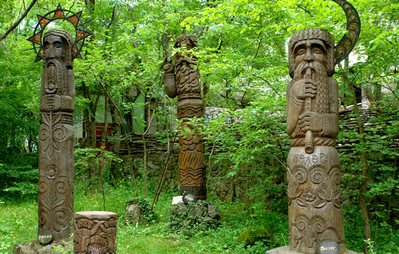
or ancient people the world around them was filled with demons, angels, devils, hobgoblins, mermaids, etc. Some of them brought trouble and disaster, could captivate into the water depths of or to the forest thicket. Others guarded the house and its comfort, protected from diseases, guarded the children. For the pagans there is nothing supernatural in the world, everything was created by the nature, is subordinated to its laws. They didn’t need any churches.
The whole world is their church and the manifestation of the divine power. The essence of religion is not in the salvation after the death, but preservation and increasing of the family, fertility of the land, protection of the lifestyle and values of the family and the kin. Therefore polytheism was not only the religion but a way of life, outlook, a way to save and reproduction of the culture and traditions from generation to generation.
Among the large number gods were few particularly important and significant:
• Perun – the god of lightning. The patron the Prince and his squads, the god of war. One of his statues at the Kiev hill is described as a wooden archer with the iron legs, silver head and gold a mustache with the precious stone in his hands.
• Dazhbog – the god of the sun, wealth, patron of the Russian lands. According to the folklore, he opens the spring. Slavs were sometimes called “the Dazhbog’s grandchildren”.
• Strybog – the god of wind, vortexes, storms. In fairy tales and myths he was described as an old man with a long beard and mustache with a bow and arrows.
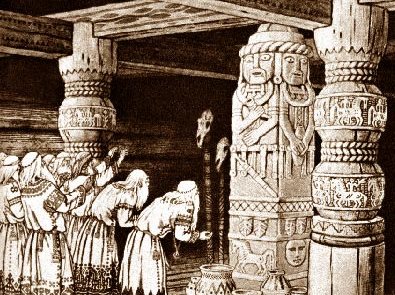
• Velez is cheerful and masterful god of music, poetry, trade, peace, animal husbandry and world of the dead. He was always represented with a pipe in his hands. According to the legend, when two tribes went to war, none of the gods was able to make the peace between them. But the soldiers stopped the fight when they heard the magical music of Velez. He could bring presents to children for the holidays.
• Svarog was the oldest god who created the world; he was the father of Dazhbog. He taught people to work, to cultivate the land, to grow crops, to bake bread. Svarog was depicted with the golden hands, in which he holds the hammer or the ax. Until now in Ukraine, praising the skills of man, we say, “He has golden hands”.
• Yarylo is young and strong barefoot god of fertility, strength and health. He was always depicted on horseback with a wreath of flowers is on his head. He has blond hair and blue or green eyes. The land where he will passes, would have a good harvest; anyone, whom he looks at, would falls in love; anyone, whom he touches, would be happy in love.
The mythology of the ancient Slavs was very complex and well-developed, many legends and myths been lost long ago in the centuries. We can say with confidence just what each one of them taught the strength and courage, love and compassion, respect for tradition and love for nature, diligence in work and training. Acquainted closer, even with a small part of the Slavic myths, you will understand the people of this country much better people not only carried the best qualities of the soul through the millennium, but also multiplied it.